

Tag Archives: Situational Awareness
8 Situational Awareness Tips That Could Save Your Life

The best self-defense tool you’ll ever carry isn’t a weapon — it’s the space between your ears. Before you ever need to draw your Byrna SD, a handful of situational awareness tips can keep you out of danger entirely. Awareness is the first line of defense, and it costs you nothing.
Most dangerous situations give off warning signs well before they escalate. People who get caught off guard weren’t unlucky — they weren’t paying attention. The good news? Awareness is a skill anyone can develop.
Whether you’re commuting through the Bay Area, walking to your car after a late shift in Sacramento, or jogging a trail in the Central Valley, these eight actionable personal safety tips can sharpen your awareness starting today.
[IMAGE: Person confidently scanning a busy California street scene — alt text: person practicing situational awareness tips in a public setting]
1. Practice the “Head on a Swivel” Rule
Every time you walk into a new space — a coffee shop, a parking lot, a trailhead — do a quick environmental scan. Look for three things: exits, people, and obstacles.
This doesn’t mean acting paranoid. It means spending five seconds observing the layout before you settle in. Where are the doors? Who’s already here? What’s between you and the way out?
With practice, this becomes completely automatic — building safety awareness habits so deeply they run in the background like a second operating system.
Quick drill: Next time you walk into a restaurant, identify two exits before you sit down. Do this for one week, and it becomes second nature.
2. Identify Exits Before You Need Them
Think about the places you visit regularly: movie theaters, grocery stores, your church or mosque, your kids’ school. How many exits can you name right now?
Most people can name only one — the door they walked in through. In an emergency, that main entrance becomes a bottleneck. Knowing alternative routes takes about three seconds and could save your life.
- Movie theaters — exits typically at the front corners near the screen
- Grocery stores — back exits near receiving docks
- Houses of worship — side doors and fellowship hall connections
- Malls — anchor store exits often lead directly outside
This habit also applies to your car. Always know the fastest route out of a parking structure.
Want to go deeper on awareness fundamentals? Read our complete Situational Awareness Guide
3. Trust Your Gut — It’s Your Built-In Threat Detector
Gavin de Becker’s groundbreaking book The Gift of Fear makes one thing clear: your intuition is a survival mechanism, not an overreaction. Your subconscious processes thousands of micro-signals — body language, tone of voice, spatial proximity — faster than your conscious brain can articulate them.
That “something feels off” sensation? It’s your brain screaming a warning.
The problem is that most of us are socialized to ignore these signals. We don’t want to seem rude. We rationalize the feeling away. Stop doing that.
If a situation feels wrong — a person approaching in a parking lot, a stranger who’s too friendly, an alley that suddenly feels too quiet — act on that feeling. Change direction. Go back inside. Move toward other people. You can always apologize later. You can’t undo what happens if you were right.
A strong self defense mindset starts with trusting yourself.
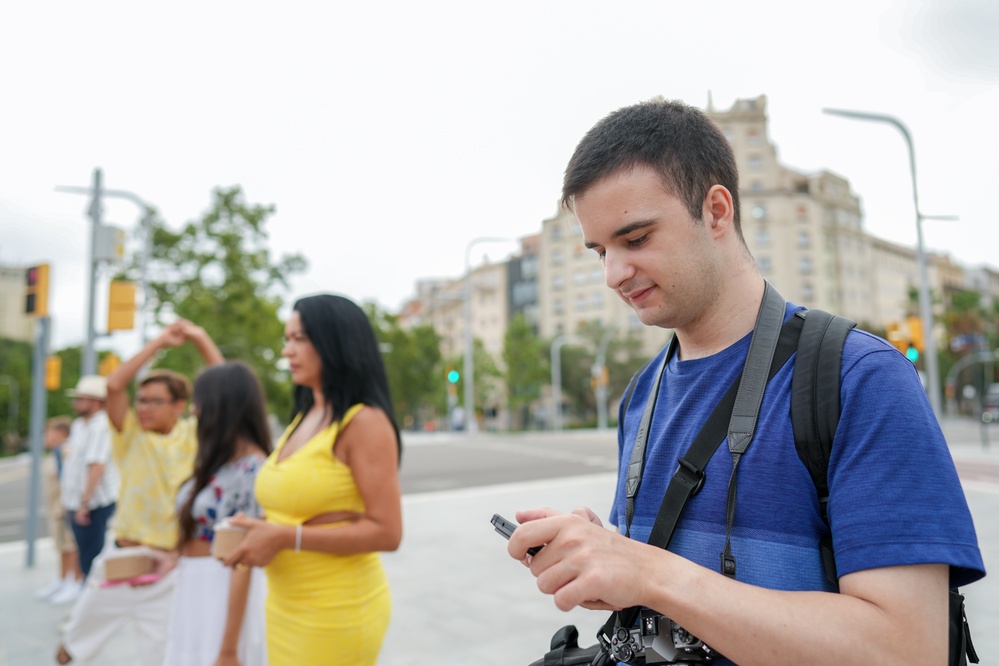
4. Put the Phone Down in Public
This might be the single most impactful tip on this list. Smartphone distraction is the number one awareness killer, and criminals know it.
People absorbed in their phones walk slower, change direction less, and are dramatically less likely to notice someone approaching. Predators target people staring at screens because those people are broadcasting one message: I’m not paying attention.
Practical rules to be aware of your surroundings:
- Walking to your car? Phone stays in your pocket.
- Waiting at a bus stop? Head up, earbuds out of at least one ear.
- Pumping gas? Eyes scanning, not scrolling.
- Unfamiliar neighborhood? Full attention on your environment.
You can answer that text in 90 seconds when you’re safely inside your car with the doors locked. Ninety seconds of patience is a small price for your safety.
5. Park Smart, Walk Smart
How and where you park matters more than most people realize.
Parking personal safety tips:
- Back into spots whenever possible — pulling forward in an emergency is significantly faster than reversing.
- Choose well-lit areas close to entrances, security cameras, or high foot traffic.
- Avoid parking next to large vans that block your sightlines on the driver’s side.
- Keys in hand before you leave the building. Digging through a bag at your car door is prime vulnerability time.
Walking smart: Walk with purpose and confidence. Head up, steady stride, shoulders back. Research shows that predators select targets who appear hesitant, distracted, or unsteady. You don’t need to look intimidating — just look like someone who’s paying attention.
6. Know Your Neighborhood’s Patterns
Some of the best safety awareness habits start on your own street. What does “normal” look like? Which cars are usually parked there? When does the mail come? What does typical foot traffic look like?
When you know the baseline, anomalies register instantly:
- An unfamiliar vehicle parked for hours with someone inside
- A person walking slowly past homes, looking into windows
- Activity at a neighbor’s house when they’re on vacation
- Someone photographing doors or locks
This isn’t about becoming a neighborhood spy. It’s about having enough awareness of your environment that unusual activity registers naturally. Many crimes — burglaries, package thefts, vehicle break-ins — are preceded by observable reconnaissance that alert neighbors notice and report.
Ready to build real skills? Book a training session at Less Lethal California and learn hands-on awareness and response techniques
7. Mentally Rehearse “What If” Scenarios
Elite military operators, law enforcement officers, and professional athletes all practice mental rehearsal. They visualize scenarios before they happen so when reality unfolds, the brain already has a response queued up.
Try these the next time you’re in each location:
- Gas station at night: What if someone approaches while you’re pumping? (Keep the car between you and them. Be ready to get in and drive.)
- Jogging trail: What if an aggressive dog charges? What if someone follows? (Know populated areas along your route. Carry a Byrna SD for deterrence.)
- Parking garage: What if someone follows you to your car? (Don’t go to it. Return to the building entrance or find security.)
- Home at night: What if someone tries the door? (Have a plan, a phone, and a less-lethal tool ready.)
Mental rehearsal doesn’t create anxiety — it reduces it. When you’ve already “solved” a scenario in your mind, you navigate the real world with more confidence.
For structured practice drills, check out our guide to 7 Byrna Drills for Monthly Practice.
8. Pair Awareness with Preparedness
Here’s the truth: awareness alone isn’t enough. Seeing a threat is step one. Having a plan — and the right tools — to respond is step two.
All the situational awareness tips in the world won’t help if you spot danger and freeze because you have no next move.
- Carry a self-defense tool you know how to use. A Byrna SD Kinetic Kit gives you a powerful, California-legal less-lethal option — no permit or background check required.
- Train regularly. Visit our shooting range to build muscle memory so your response is fast under stress.
- Take a course. Our Less Lethal Training Course at our Manteca, CA facility combines awareness fundamentals with practical launcher skills.
Awareness tells you when. Preparedness tells you how. Together, they form a complete personal safety system.
[IMAGE: Byrna SD launcher alongside training materials at Less Lethal California facility — alt text: pair situational awareness with Byrna preparedness training]
Frequently Asked Questions
How can I improve my situational awareness quickly?
Start with two habits: put your phone away in public, and identify exits every time you enter a new space. These changes alone will dramatically improve how much you notice daily. From there, work through the other situational awareness tips in this list one at a time until they’re automatic. For a deeper dive, read our full Situational Awareness Guide.
What is the best book on situational awareness?
The Gift of Fear by Gavin de Becker is widely considered the gold standard. It explains how your intuition works as a survival tool and why you should trust it. For a more tactical perspective, Left of Bang by Patrick Van Horne and Jason A. Riley teaches you to read body language and behavioral cues the way Marines do. Both build a stronger self defense mindset.
Is situational awareness training available near me?
If you’re in California’s Central Valley, yes. Less Lethal California in Manteca offers hands-on training combining situational awareness fundamentals with practical Byrna launcher skills. Our Less Lethal Training Course is designed for everyday Californians — no prior experience required. Contact us to learn about upcoming sessions.
Awareness + Preparedness = Safety
These eight situational awareness tips aren’t complicated. They don’t require special training, expensive gear, or years of practice. They just require the decision to start paying attention — today.
When you combine a sharp, alert mind with the right tools and real-world training, you become genuinely harder to victimize. Not because you’re looking for trouble, but because you’re ready if it finds you.
California’s first Byrna-dedicated training facility is right here in Manteca. Whether you’re brand new to self-defense or sharpening existing skills, we’re here to help.
Get trained at Less Lethal California — awareness skills, Byrna proficiency, and real-world confidence. Book your session today
Situational Awareness: The #1 Self-Defense Skill You’re Not Practicing
You can own the best self-defense tools in the world — a Byrna SD Kinetic Kit, pepper spray, a personal alarm — but if you don’t see the threat coming, none of it matters. Situational awareness is the single most important skill in your personal safety toolkit, and yet most people have never practiced it for a single day.
Criminals don’t pick targets at random. They pick the person staring at their phone in the parking lot, the jogger with earbuds on full blast, the driver sitting in an idling car without a care in the world. They pick the person who isn’t paying attention.
In this guide, you’ll learn exactly what situational awareness is, how to train your brain using the Cooper Color Code system, and seven practical habits you can start building today — no matter where you live in California.

What Is Situational Awareness?
Situational awareness is more than a vague reminder to “be aware of your surroundings.” It’s a deliberate mental state — the practice of actively observing and processing what’s happening around you so you can identify potential threats before they become emergencies.
It’s the difference between seeing and observing. You see a hundred people at the grocery store. But do you observe the person lingering near the exit for 20 minutes watching shoppers leave with full carts?
The good news? Self defense awareness isn’t something you’re born with. It’s a trainable skill — like driving or cooking. At first it takes deliberate effort. Over time, it becomes second nature. And the best framework for building it is the Cooper Color Code.
Want hands-on training in situational awareness? Book a session at Less Lethal California
Why Situational Awareness Is Your First Line of Defense
Every self-defense expert will tell you the same thing: prevention beats reaction every time. The best fight is the one you never have.
- Criminals conduct interviews. Before acting, most attackers assess targets for distraction, isolation, and vulnerability. Your awareness — or lack of it — is the first thing they evaluate.
- Reaction time is a luxury. The average physical assault unfolds in under three seconds. If you don’t spot warning signs ahead of time, you’re already behind.
- Distracted targets are easier targets. Victims engaged in a secondary activity (texting, listening to music) at the time of an attack are significantly less likely to take protective action.
A Real-World Scenario
You’ve just left a late dinner in downtown Sacramento and enter a parking garage scrolling your phone. You don’t notice someone following you in from the sidewalk.
Now rewind. Same scenario, but you’ve been practicing situational awareness. You glance behind you before entering. You notice someone changing direction to follow. You make eye contact — a universal signal that says, “I see you.” You change course toward the lit security booth.
Threat averted. No confrontation. No weapon needed. Just awareness. That’s why situational awareness is your first line of defense — and a Byrna launcher is your second.
The Cooper Color Code Explained
The Cooper Color Code was developed by Marine Lt. Col. Jeff Cooper and is the gold standard framework used by law enforcement and personal safety professionals worldwide. It breaks your mental state into four levels of readiness.
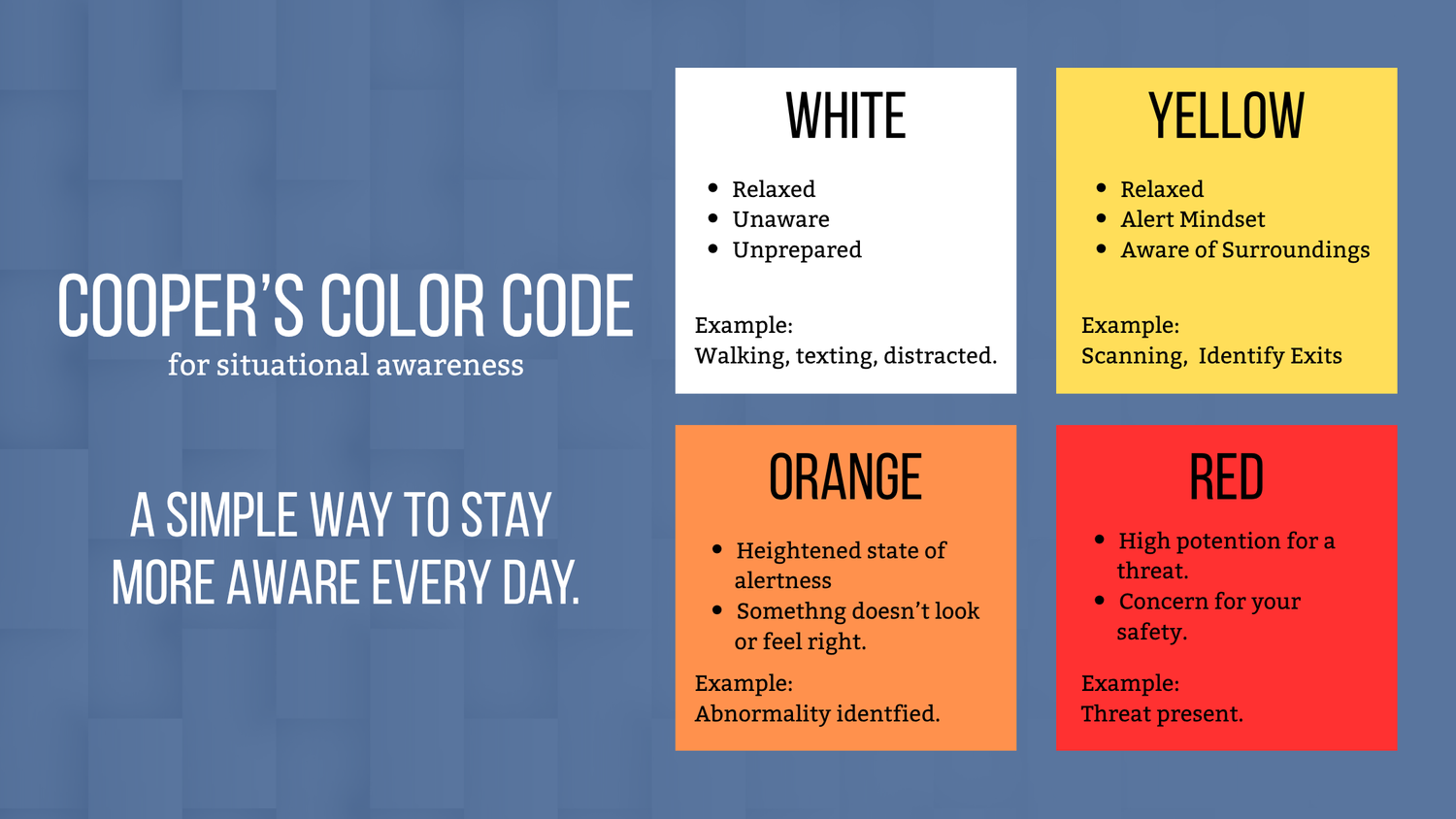
Condition White — Unaware and Unprepared
The state most people live in. You’re absorbed in your phone, lost in thought, or on autopilot. If a threat materializes, your brain must go from zero to crisis mode instantly — and that delay can cost you everything.
Common examples: Walking through a parking lot texting. Wearing noise-canceling headphones on public transit. Sitting in your car at a gas station scrolling social media.
Condition Yellow — Relaxed Alert (Your Default)
This is where you want to live. You’re aware but not anxious — casually scanning your environment, noting exits, and paying attention to anything that breaks the normal pattern.
What it looks like: Glancing around a restaurant when you sit down. Scanning a parking lot before getting out. Making brief eye contact with people you pass. You’re not looking for threats — you’re looking for anomalies.
Condition Orange — Specific Alert
Something has triggered your attention. A person is following you. A car has circled the block three times. Your gut says something is off. You’ve identified a specific potential concern and you’re forming a plan: exit routes, where your tools are, how to move toward safety.
This is where preparation meets awareness. If you’ve trained and mentally rehearsed, Condition Orange feels manageable. If you haven’t, it feels like panic.
Condition Red — Action Required
The threat is real and immediate. You execute the plan you formed in Orange — move to your exit, deploy your Byrna SD, call 911. You act decisively because you saw it coming.
Practice transitioning through the Cooper Color Code in real scenarios at our Manteca facility
7 Practical Habits to Build Situational Awareness
Knowing the theory is one thing. Living it is another. Here are seven personal safety tips you can start practicing today.
1. Scan Every Room When You Enter
Every time you walk into a new space, take five seconds: Exits (doors, emergency exits, windows). People (anyone behaving unusually?). Obstacles (what’s between you and the exit?). Over time, this becomes automatic.
2. Limit Phone Use in Public
Your phone is the biggest threat to your awareness. When your face is in a screen, peripheral vision drops to almost nothing and reaction time plummets. Rule of thumb: If you must use your phone in public, stop walking, put your back to a wall, and keep your head up between glances.
3. Trust Your Gut — The “Gift of Fear”
Security expert Gavin de Becker’s The Gift of Fear explains that your subconscious processes danger signals faster than your conscious mind can name them. That “bad feeling”? It’s your brain’s pattern-recognition system at work. Never rationalize it away.
4. Park Smart
Parking is one of your most vulnerable routines. Back into spaces so you can pull out quickly. Choose well-lit spots near entrances. Have keys in hand before you reach your car. Check your back seat. Lock doors immediately once inside.
5. Know Your Neighborhood Patterns
Awareness is easier when you know what “normal” looks like. Pay attention to your neighborhood’s rhythm — who walks their dog when, which cars are usually parked on your street. When something breaks the pattern, your brain flags it automatically.
6. Practice “What If” Mental Rehearsal
Throughout your day, play a quiet game: What if someone tried to grab my bag right now? What if I heard gunshots in this store — where’s the nearest exit? This isn’t paranoia — it’s the same mental rehearsal used by military operators and first responders. Pre-solved scenarios execute faster.
7. Pair Awareness with Preparedness
Situational awareness tells you when something is wrong. Preparedness gives you something to do about it. Carrying a Byrna SD Kinetic Kit means that when you move from Yellow to Orange, you already have a less-lethal option ready. That’s the difference between awareness alone and true self-defense readiness.
Pair your awareness skills with the right tools — shop the Byrna SD Kinetic Kit
Situational Awareness for California-Specific Scenarios
California’s diverse landscape creates unique safety considerations. Here’s how to apply self defense awareness to environments you actually navigate.
Urban Environments — LA, SF, Sacramento
Crowded streets provide cover for pickpockets and follow-home robberies. Keep bags in front of you. Avoid walking between parked cars and buildings. Be especially alert when transitioning between environments — leaving a store, exiting transit.
Trailheads and Parks
Isolated trailheads pose risks for solo hikers and runners. Tell someone your route and return time. Be cautious of people lingering in parking areas who aren’t gearing up. Carry a personal safety tool — cell service isn’t guaranteed on many CA trails.
Gas Stations and ATMs
Common locations for opportunistic crime — you’re stationary and often distracted. Choose well-lit, busy locations. Stay standing outside your vehicle so you can move quickly. Complete your transaction and leave.
Open Houses and Real Estate Showings
Real estate professionals meet strangers in empty buildings regularly. Always share the address and time with someone. Walk the property before clients arrive. Consider carrying a Byrna launcher as a non-lethal safety option.
Real estate professionals: read our full safety guide
Building a Security Mindset
“Isn’t this just paranoia?” No — and here’s the difference.
Fear-based awareness is reactive, anxious, and exhausting. It sees threats everywhere and leaves you drained. Empowerment-based awareness — a true security mindset — is calm, confident, and sustainable. It’s not about expecting the worst. It’s about being prepared for the worst while expecting the best.
Daily Mindset Rituals
- Morning: Before leaving the house, think about where you’re going and set an intention to stay in Condition Yellow.
- Transitions: Every time you move between environments — car to store, office to parking lot — use it as a trigger to scan and reset.
- Evening: Briefly reflect. Were there moments you slipped into White? What triggered it?
These rituals take minutes but compound into a rock-solid security mindset over time.
Why a security mindset matters for your community
Awareness + Preparedness = True Safety
Here’s the equation: Situational awareness identifies the threat. Preparedness gives you a response.
- Awareness without tools = You see danger coming but can’t respond if avoidance fails.
- Tools without awareness = You have a self-defense option you’ll never deploy in time.
A Byrna launcher bridges the gap between recognizing a threat and responding to it — less-lethal, legal in California without a permit, and effective at creating distance. But it only works if you’ve trained yourself to see the threat early enough to use it.
That’s why we pair situational awareness training with hands-on Byrna proficiency at our Manteca facility. Carrying a tool you haven’t trained with, in a mind that hasn’t practiced awareness, isn’t a safety plan. It’s wishful thinking.
Train Your Awareness at Less Lethal California
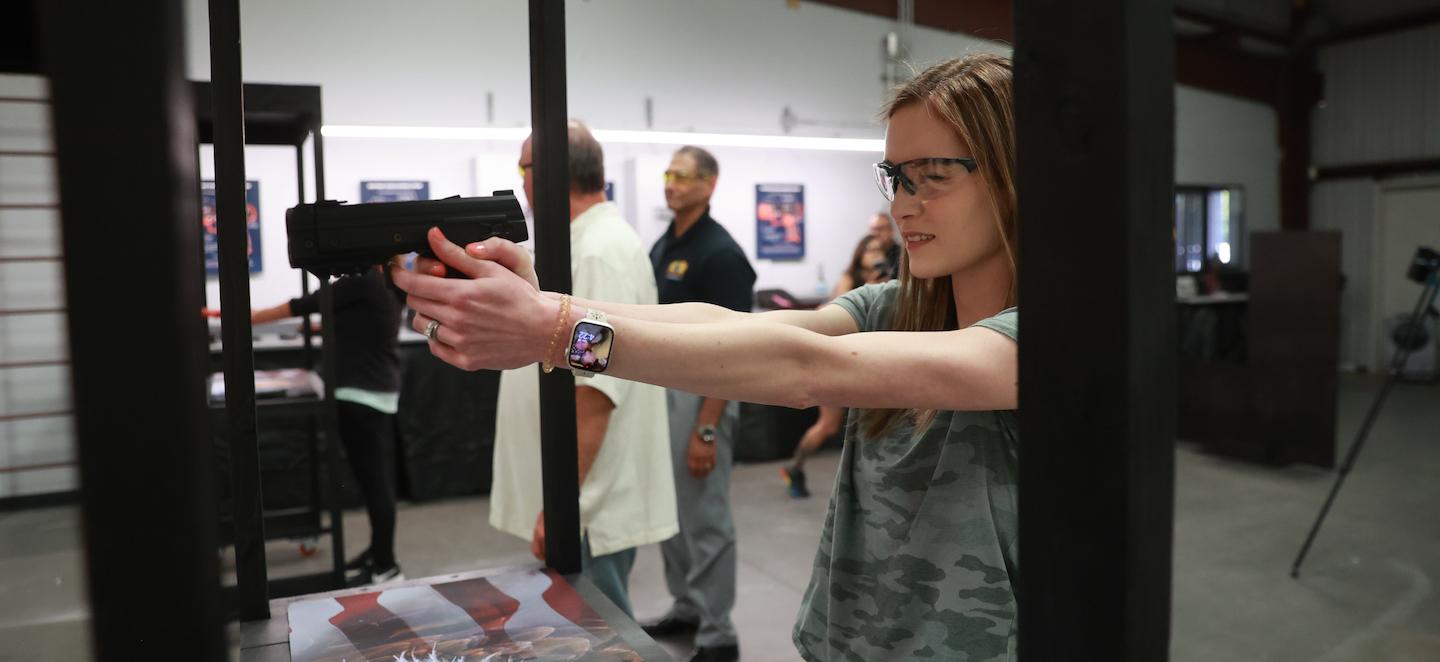
Reading about situational awareness is a great start. The real transformation happens when you practice in realistic, scenario-based training.
At Less Lethal California’s training facility in Manteca, we offer:
- Scenario-based drills where you practice identifying threats and making decisions under pressure
- Byrna launcher proficiency so your muscle memory matches your mental readiness
- Range time on our dedicated shooting range to practice deploying your Byrna accurately
- Personalized coaching tailored to your daily environments — commuter, parent, real estate pro, or college student
You’ll walk out with more than knowledge. You’ll walk out with confidence — the quiet, earned kind that comes from knowing you can see a threat coming and do something about it.
Book your situational awareness and Byrna training session today
Frequently Asked Questions
How can I improve my situational awareness?
Start with the seven habits above — especially scanning rooms when you enter, limiting phone use in public, and practicing “what if” mental rehearsal. The biggest single change is training yourself to live in Condition Yellow rather than Condition White. For accelerated improvement, take a hands-on training course that tests your awareness under realistic pressure.
What is the Cooper Color Code?
The Cooper Color Code is a mental awareness system developed by Marine Lt. Col. Jeff Cooper. It defines four levels: White (unaware), Yellow (relaxed alert — your ideal default), Orange (specific alert — something concerns you), and Red (action — confirmed threat requiring immediate response). It’s the foundation of self defense awareness used by professionals worldwide.
Is situational awareness training available near me in California?
Less Lethal California in Manteca offers scenario-based situational awareness training paired with Byrna launcher proficiency courses. We’re California’s first Byrna-dedicated training facility and welcome all experience levels — complete beginners to experienced carriers looking to sharpen their skills.
What should I do if I sense danger in public?
Trust your instincts first. Move toward other people or a well-lit area. Create distance from the source of concern. Make eye contact if safe — this signals you’re aware and not an easy target. Have your phone ready for 911. If you carry a Byrna SD, ensure it’s accessible. And always have an exit plan — which you’ll already have if you’ve been practicing Condition Yellow.
Your Next Step: Stop Reading, Start Practicing
For the next seven days, practice one new habit from this list each day. By the end of the week, you’ll notice a difference in how you move through the world — more present, more confident, more in control.
When you’re ready to take it further — to train your awareness alongside a less-lethal tool that gives you real options — come see us. Less Lethal California is California’s first Byrna-dedicated training facility in Manteca, CA. We’ll help you build the situational awareness and the hands-on skills to back it up.
Your safety isn’t about luck. It’s about preparation. And preparation starts now.
Book your training session at Less Lethal California — Manteca, CA