

Self-Defense Guide
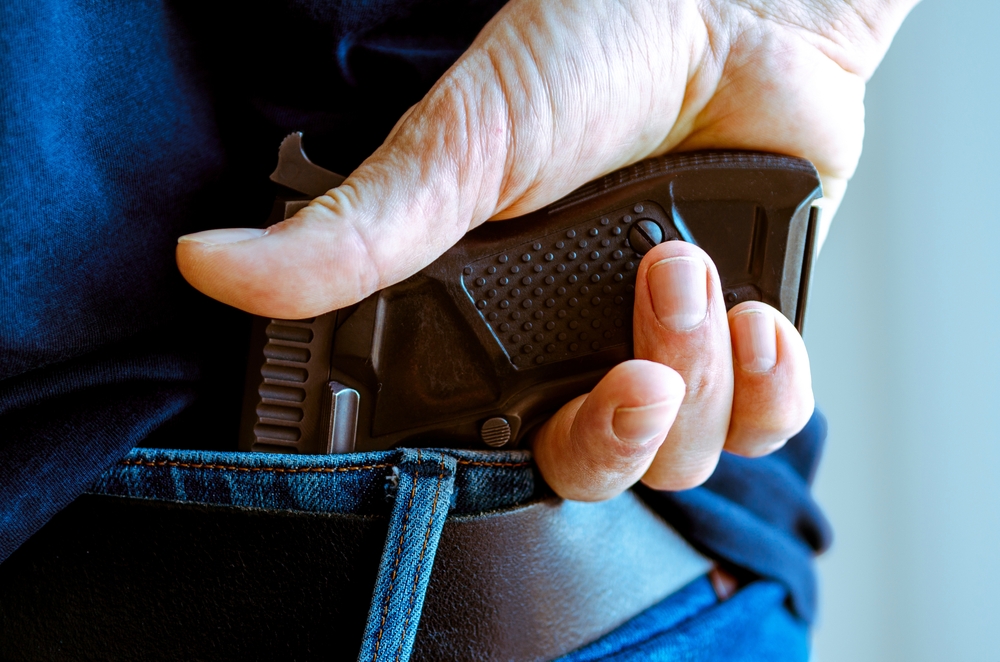
5 Self-Defense Scenarios Where Byrna Outperforms a Firearm

A firearm is a powerful self-defense tool — but it’s not always the right tool. When it comes to byrna vs firearm, most people assume lethal force is the gold standard for personal protection. The truth is more nuanced. In the vast majority of real-world confrontations Californians face, a Byrna launcher delivers a tactical and legal advantage that a handgun simply can’t match.
We’re not here to bash firearms. We’re here to show you five scenarios where reaching for a Byrna is the smarter, safer, and more legally defensible choice. If you’re weighing your options, this breakdown will change how you think about byrna vs firearm self-defense.
[IMAGE: Split-image comparison of Byrna launcher and firearm in home-defense context — alt text: “byrna vs firearm comparison for California self-defense scenarios”]
1. Apartment or Shared-Wall Living
If you live in a California apartment, condo, or townhome, you already know your walls are thin. What you might not realize is just how dangerous that makes a firearm for home defense.
A standard 9mm round can penetrate multiple layers of drywall — traveling through your wall, into a neighbor’s living room, and potentially striking someone you never intended to harm. Even hollow-point ammunition can still pass through interior walls at close range.
Byrna kinetic rounds stop on impact. They deliver 60 joules of energy directly to the target without the risk of punching through sheetrock into the next unit. For California’s 17 million+ renters, that distinction isn’t theoretical — it’s life-saving.
- 9mm FMJ penetration: Passes through 6-8 sheets of drywall
- Byrna .68 caliber kinetic round: Stops on the first solid surface
When your neighbor’s toddler is sleeping eight feet from your bedroom wall, the less lethal advantages of a Byrna aren’t a compromise — they’re a responsibility.
Explore the Byrna SD Kinetic Kit — built for close-quarters defense
2. When Family Members Are Nearby
Home invasions don’t happen on a neat shooting range with a clear lane and a backdrop. They happen at 2 a.m. with your kids asleep down the hall, your spouse behind you, or your elderly parent in the next room.
In a high-stress situation, even trained shooters experience:
- Degraded fine motor skills under adrenaline
- Tunnel vision that narrows target awareness
- Missed shots — law enforcement hit rates average only 18-30% in real encounters
Every round that misses its target keeps traveling. In a home full of family members, that’s an unacceptable risk.
A Byrna launcher gives you a forceful, incapacitating response without the catastrophic consequences of a stray bullet. Chemical irritant rounds fill a space and force an intruder to retreat — all without the risk of a round traveling through a bedroom door.
When the people you’re protecting are just feet away, byrna self defense means defending everyone in the home — not just yourself.
How effective are Byrna kinetic rounds in real scenarios?
3. Road Rage or Parking Lot Confrontations
Road rage incidents in California have surged in recent years. An aggressive driver follows you into a parking lot. Someone gets out of their car screaming, chest-puffed, fists clenched. You feel threatened — but is your life in imminent danger?
Here’s the legal reality: if you draw a firearm in this situation, you may be committing felony brandishing under California Penal Code 417. Even if the other person was the aggressor, pulling a gun on an unarmed person can land you in handcuffs.
California’s self-defense framework requires proportional force. That’s where the Byrna changes the equation:
- Unarmed aggressor approaching you? Byrna kinetic rounds are a proportional, legally defensible response.
- No visible weapon but aggressive posturing? A Byrna creates distance without the legal exposure of a firearm.
- Need to de-escalate fast? The sight and sound of a Byrna firing can stop a confrontation instantly.
This is the scenario where understanding non lethal vs lethal force options can keep you out of prison while keeping you safe. Know the California self-defense laws every Byrna owner should understand.
Learn proper use-of-force decision-making at our Manteca training center
4. When the Threat Is Ambiguous
Not every threat announces itself clearly. You’ll face situations where something feels wrong but the threat level is genuinely unclear:
- A drunk stranger stumbles onto your property at night — confused, not malicious
- A mentally unwell person is agitated and approaching — unpredictable, but possibly unarmed
- A trespasser is in your backyard — unknown intent, unknown weapons
In each case, lethal force is almost certainly not legally justified in California. But doing nothing isn’t an option when your family’s safety is at stake.
This is the gap a Byrna fills — and it’s a gap most firearm owners don’t realize exists until they’re in the moment. When to use byrna comes down to a simple test: Is the threat real enough to require action, but unclear enough that a bullet would be disproportionate?
If yes, a Byrna gives you:
- Immediate stopping power via kinetic impact
- Area denial via chemical rounds (pepper/tear gas)
- Legal defensibility — proportional force is always easier to defend
- Moral clarity — you stopped a threat without taking a life unnecessarily
The Byrna doesn’t replace your judgment. It gives you more options when your judgment tells you a firearm is too much.
[IMAGE: Person holding Byrna launcher at home entryway at night — alt text: “byrna self defense for ambiguous threat situations at home in California”]
5. Dog Attacks While Walking or Jogging
This one surprises people, but it shouldn’t. Dog attacks are increasingly common in suburban California — and they’re one of the clearest scenarios where a Byrna outperforms a firearm.
- California leads the nation in dog bite claims, with over 2,000 reported attacks annually
- Suburban neighborhoods and walking trails are the most common locations
- Victims are often joggers, dog walkers, and children
No reasonable person wants to shoot a dog. But an aggressive, charging animal is a genuine threat — especially large breeds capable of inflicting serious injury.
Byrna pepper rounds are highly effective on aggressive dogs. The capsaicin compound causes immediate disorientation and retreat behavior — without permanent injury. It’s the same active ingredient used by postal workers and animal control professionals.
- Humane deterrence that stops the attack without killing the animal
- Range advantage — engage from 15-20 feet before the dog reaches you
- No legal complications from discharging a firearm in a residential area
- Peace of mind on every walk, jog, or bike ride
For California outdoor enthusiasts, this is one of the most practical everyday applications of byrna self defense.
See the full Byrna product lineup for everyday carry
When a Firearm IS the Right Choice
Honesty means acknowledging that a Byrna isn’t the answer to every threat. There are scenarios where lethal force is the only appropriate response:
- Active shooter situations where a gunman is firing on people
- Multiple armed attackers where lethal force is the only option for survival
- Imminent lethal threats — someone with a weapon at close range, a firearm pointed at you
In these moments, a firearm may be the only tool that stops the threat in time. We’re pro-self-defense, not anti-gun. Many of our students at Less Lethal California are experienced firearm owners who recognized a gap in their defense toolkit.
The question isn’t firearm or Byrna. It’s knowing when each tool is appropriate — and having the training to make that decision under pressure.
The Best Approach? Carry Both
Here’s what experienced self-defense practitioners understand: different threats require different tools.
A firearm covers the 10% of scenarios involving imminent lethal threats. A Byrna covers the 90% of real-world confrontations that don’t rise to that level — the road rage incidents, the ambiguous trespassers, the aggressive dogs, the situations where pulling a gun would escalate danger or land you in legal trouble.
Many Byrna owners also carry firearms. They’re building a layered self-defense strategy that gives them options for every scenario. The less lethal advantages of adding a Byrna include:
- Graduated force response — match your tool to the actual threat level
- Reduced legal exposure — proportional force is easier to defend in court
- Greater confidence — you’re prepared for the full spectrum of confrontations
- Family-safe home defense — the Byrna handles what a firearm shouldn’t
The best-prepared Californians aren’t choosing sides in the non lethal vs lethal debate. They’re equipping themselves for reality.
Read the full Byrna vs firearm comparison
Frequently Asked Questions
Can a Byrna actually stop an attacker?
Yes. Byrna kinetic rounds deliver approximately 60 joules of energy — comparable to the pain of a professional fastball hitting bare skin. The impact causes immediate pain, bruising, and often involuntary retreat. Combined with chemical irritant rounds (pepper or tear gas), a Byrna can incapacitate an aggressor through pain, disorientation, and respiratory distress. Byrna launchers are proven effective in real-world encounters. Proper training dramatically increases your effectiveness.
Is it legal to use a Byrna in a road rage situation in California?
California law permits the use of reasonable and proportional force in self-defense. If you’re confronted by an aggressive, threatening individual and you reasonably believe you are in danger of bodily harm, deploying a Byrna is generally considered a proportional response — especially against an unarmed aggressor. However, every situation is unique. We strongly recommend completing a less lethal training course to understand use-of-force decision-making under California self-defense law.
Should I own both a Byrna and a firearm?
If you’re legally able to own both, yes — most self-defense experts recommend a layered approach. A firearm addresses lethal-force scenarios. A Byrna covers the much larger category of confrontations where lethal force isn’t justified, legally defensible, or safe for bystanders. Many of our students at Less Lethal California own both and train with both.
[IMAGE: Byrna SD and training class setup at Less Lethal California — alt text: “byrna vs firearm training at Less Lethal California Manteca”]
Experience the Difference for Yourself
Reading about the byrna vs firearm comparison is a great start — but nothing replaces hands-on experience. At Less Lethal California in Manteca, you can fire a Byrna on our dedicated shooting range, learn use-of-force decision-making from certified instructors, and walk away with the confidence to protect yourself and your family in any scenario.
Whether you’re a first-time buyer or a seasoned firearms owner looking to fill the gap in your toolkit, we’re here to help.
Book your training session or visit our shooting range today
Shop the Byrna SD Kinetic Kit — California’s most popular less lethal launcher
5 California Self-Defense Laws Every Byrna Owner Must Know
Owning a Byrna launcher is 100% legal in California. But knowing you can own one and understanding when and how you can legally use it are two very different things. If you carry a Byrna for personal protection, you need a solid grasp of California self defense law before you ever need to deploy it.
The good news? California’s legal framework actually favors less lethal tools like the Byrna in many self-defense scenarios. The key is understanding the rules before a high-stress moment forces you to act.
Here are the five most important self defense laws California Byrna owners must know.
Want hands-on training on California use-of-force laws? Book a Less Lethal Training Course
1. California’s Castle Doctrine (PC 198.5) — Your Right to Defend Your Home
The castle doctrine California law is one of the strongest legal protections available to homeowners. Under Penal Code 198.5, if someone unlawfully and forcibly enters your occupied home, you are presumed to have a reasonable fear of imminent death or great bodily harm.
In practical terms, this means:
- You do not have to retreat inside your own home.
- The legal presumption is in your favor — the burden shifts to the intruder.
- You can use force — including deploying a Byrna launcher — to stop the threat.
How the Castle Doctrine Applies to Byrna Use
A Byrna SD Kinetic Kit firing kinetic or chemical irritant rounds provides a powerful, incapacitating response without the permanence and legal complexity of lethal force.
In a home invasion scenario, deploying your Byrna can:
- Stop an intruder immediately with impact and chemical deterrent rounds
- Demonstrate proportional response to investigators and prosecutors
- Protect your family without the devastating consequences of a fatal shooting
The castle doctrine gives you legal ground to stand on. A Byrna gives you a practical, effective way to exercise that right.
Protect your home with a Byrna SD Kinetic Kit — Shop now
2. SB-2 and Concealed Carry Changes — What Byrna Owners Need to Know
California’s concealed carry landscape underwent a massive overhaul with SB-2, signed into law in 2023. This legislation dramatically expanded the list of “sensitive places” where concealed firearms are prohibited and tightened CCW permit requirements.
If you’ve been following the sb 2 ccw developments, you know the headaches — new restrictions on where permit holders can carry, additional training mandates, and ongoing legal challenges have left many Californians confused.
Why SB-2 Makes the Byrna Even More Relevant
Here’s the critical distinction: a Byrna launcher is not a firearm under California law. That means:
- No CCW permit required to carry a Byrna
- SB-2’s sensitive place restrictions do not apply
- No background check or waiting period to purchase
- No registration requirements
While firearm owners navigate an increasingly complex web of carry restrictions, Byrna owners maintain a straightforward, legal self-defense option that travels with them almost everywhere.
We wrote an in-depth breakdown of this legislation. If you haven’t read it yet, start here: SB-2 CCW Explained: What California Residents Need to Know
For a broader look at concealed carry in the state, check out our complete concealed carry guide for Californians .
3. Duty to Retreat vs. Stand Your Ground — California’s Key Distinction
One of the most misunderstood aspects of California self defense law is whether you have to retreat before using force. Let’s clear it up.
California is NOT a stand your ground state — at least not in the way Texas or Florida define it.
Here’s how it works:
- In public, California law generally expects you to retreat if you can do so safely before resorting to force.
- In your home, you have no duty to retreat (Castle Doctrine applies).
- If retreat isn’t safely possible, you may use reasonable force to defend yourself even in public.
What This Means for Byrna Carriers
If you carry a Byrna in public, the stand your ground California question is directly relevant. You should always:
- Attempt to de-escalate the situation verbally if possible
- Retreat or create distance if you can do so safely
- Deploy your Byrna only when retreat is not safely possible and you face a genuine threat
The Byrna gives you an advantage here. Its effective range of up to 60 feet allows you to create distance while maintaining a defensive option — unlike pepper spray or a stun gun that require close proximity.
Understanding the duty to retreat is one of the most important things we cover in our training courses. It’s the difference between a justified use of force and a potential legal problem.
Learn proper use of force and de-escalation techniques — Book a training session
4. Proportional Force Doctrine — The Byrna’s Biggest Legal Advantage
California law requires that any force used in self-defense be proportional to the threat. This is where a less lethal launcher gives you a serious legal advantage.
The proportional force doctrine means:
- You cannot use deadly force against a non-deadly threat
- The force you use must be reasonable given the circumstances
- Excessive force — even in a legitimate self-defense situation — can lead to criminal charges against you
Why Less Lethal = Legal Advantage
Think about the scenarios most Californians actually face: aggressive confrontations, attempted muggings, road rage incidents, or trespassing. The majority of these threats do not justify lethal force — but they absolutely justify a defensive response.
A Byrna kinetic or chemical round:
- Delivers immediate, incapacitating pain without permanent injury in most cases
- Matches the proportional force standard for a wide range of real-world threats
- Reduces your legal exposure compared to drawing a firearm
- Gives prosecutors and juries a clear narrative — you chose minimum necessary force
As we detail in our Byrna vs. firearm comparison, the legal aftermath of deploying a Byrna is dramatically different from discharging a firearm — even when the shoot is justified.
When you choose a Byrna, you choose a tool that aligns with how self defense laws California courts actually evaluate force.
5. Restricted Locations & Where You Can Carry Your Byrna
Even though the Byrna doesn’t fall under California’s firearm regulations, carrying any defensive tool requires location awareness.
Where You Can Generally Carry a Byrna
- On your person in most public spaces (no permit needed)
- In your vehicle — glove box, center console, or bag
- At your home or business
- While hiking, camping, or in outdoor recreation areas
Where Restrictions May Apply
- Schools and school grounds (K-12) — Penal Code sections may restrict certain projectile devices on campus. Always verify current regulations.
- Government buildings — courthouses, federal buildings, and secured facilities prohibit weapons of all types past security checkpoints.
- Private property with posted restrictions — businesses and property owners can prohibit weapons on their premises.
- Airports — TSA prohibits Byrna launchers and CO2 cartridges in carry-on luggage.
- Events with security screening — concerts and sporting venues will likely confiscate self-defense tools.
Practical Carry Tips
- Know before you go. Check restrictions before heading somewhere unfamiliar.
- Store it securely in your vehicle when entering restricted buildings.
- Carry concealed. Just because it’s byrna legal California-wide doesn’t mean you should display it unnecessarily. Low-profile carry avoids confrontation.
Important Legal Disclaimer
This content is for educational purposes only. This is not legal advice. California laws are complex, subject to change, and may be interpreted differently depending on jurisdiction and circumstances.
Laws referenced in this post reflect our understanding as of the publish date. Regulations can and do change through new legislation, court rulings, or local ordinances.
Always consult a licensed California attorney for legal advice specific to your situation. If you’re involved in a self-defense incident, contact law enforcement and an attorney immediately.
Frequently Asked Questions
Is it legal to carry a Byrna in California without a permit?
Yes. The Byrna launcher is not classified as a firearm in California. You do not need a CCW permit, background check, or special license to purchase or carry one. There is no waiting period or registration requirement. However, be aware of location-specific restrictions like schools, government buildings, and private properties that prohibit weapons. For more details, read our concealed carry guide.
Can I use a Byrna to defend someone else in California?
California law does allow the use of force in defense of others. Under Penal Code 694 and related statutes, you may use reasonable force to defend another person if you reasonably believe they face imminent harm. The same rules apply: force must be proportional, and you should retreat if safely possible. A Byrna is well-suited for third-party defense because its less lethal nature reduces the risk of catastrophic outcomes.
What happens legally if I use a Byrna in self-defense?
If you deploy a Byrna in self-defense, the legal process mirrors any use-of-force incident. Call 911 immediately, cooperate with law enforcement, and contact an attorney. Investigators will evaluate whether your force was reasonable and proportional. The less lethal nature of the Byrna often works in your favor — it demonstrates a measured response rather than escalation to deadly force. That said, any use of force can result in legal scrutiny, which is why we strongly recommend formal training on use-of-force principles.
Know the Law. Carry with Confidence.
Understanding California self defense law isn’t optional — it’s a responsibility that comes with carrying any self-defense tool. These five laws — castle doctrine protections, SB-2 implications, duty to retreat principles, proportional force standards, and carry restrictions — form the legal foundation every Byrna owner needs.
The best way to internalize these concepts isn’t just reading about them. It’s practicing them in realistic scenarios with expert guidance.
events 2 min
At Less Lethal California, our training courses cover California-specific use-of-force law, de-escalation techniques, and live-fire Byrna drills at our Manteca facility — California’s first Byrna-dedicated training center.
Don’t wait until you’re in a high-pressure situation to figure this out. Get trained now and carry with the confidence that comes from knowing the law is on your side.
Situational Awareness: The #1 Self-Defense Skill You’re Not Practicing
You can own the best self-defense tools in the world — a Byrna SD Kinetic Kit, pepper spray, a personal alarm — but if you don’t see the threat coming, none of it matters. Situational awareness is the single most important skill in your personal safety toolkit, and yet most people have never practiced it for a single day.
Criminals don’t pick targets at random. They pick the person staring at their phone in the parking lot, the jogger with earbuds on full blast, the driver sitting in an idling car without a care in the world. They pick the person who isn’t paying attention.
In this guide, you’ll learn exactly what situational awareness is, how to train your brain using the Cooper Color Code system, and seven practical habits you can start building today — no matter where you live in California.

What Is Situational Awareness?
Situational awareness is more than a vague reminder to “be aware of your surroundings.” It’s a deliberate mental state — the practice of actively observing and processing what’s happening around you so you can identify potential threats before they become emergencies.
It’s the difference between seeing and observing. You see a hundred people at the grocery store. But do you observe the person lingering near the exit for 20 minutes watching shoppers leave with full carts?
The good news? Self defense awareness isn’t something you’re born with. It’s a trainable skill — like driving or cooking. At first it takes deliberate effort. Over time, it becomes second nature. And the best framework for building it is the Cooper Color Code.
Want hands-on training in situational awareness? Book a session at Less Lethal California
Why Situational Awareness Is Your First Line of Defense
Every self-defense expert will tell you the same thing: prevention beats reaction every time. The best fight is the one you never have.
- Criminals conduct interviews. Before acting, most attackers assess targets for distraction, isolation, and vulnerability. Your awareness — or lack of it — is the first thing they evaluate.
- Reaction time is a luxury. The average physical assault unfolds in under three seconds. If you don’t spot warning signs ahead of time, you’re already behind.
- Distracted targets are easier targets. Victims engaged in a secondary activity (texting, listening to music) at the time of an attack are significantly less likely to take protective action.
A Real-World Scenario
You’ve just left a late dinner in downtown Sacramento and enter a parking garage scrolling your phone. You don’t notice someone following you in from the sidewalk.
Now rewind. Same scenario, but you’ve been practicing situational awareness. You glance behind you before entering. You notice someone changing direction to follow. You make eye contact — a universal signal that says, “I see you.” You change course toward the lit security booth.
Threat averted. No confrontation. No weapon needed. Just awareness. That’s why situational awareness is your first line of defense — and a Byrna launcher is your second.
The Cooper Color Code Explained
The Cooper Color Code was developed by Marine Lt. Col. Jeff Cooper and is the gold standard framework used by law enforcement and personal safety professionals worldwide. It breaks your mental state into four levels of readiness.
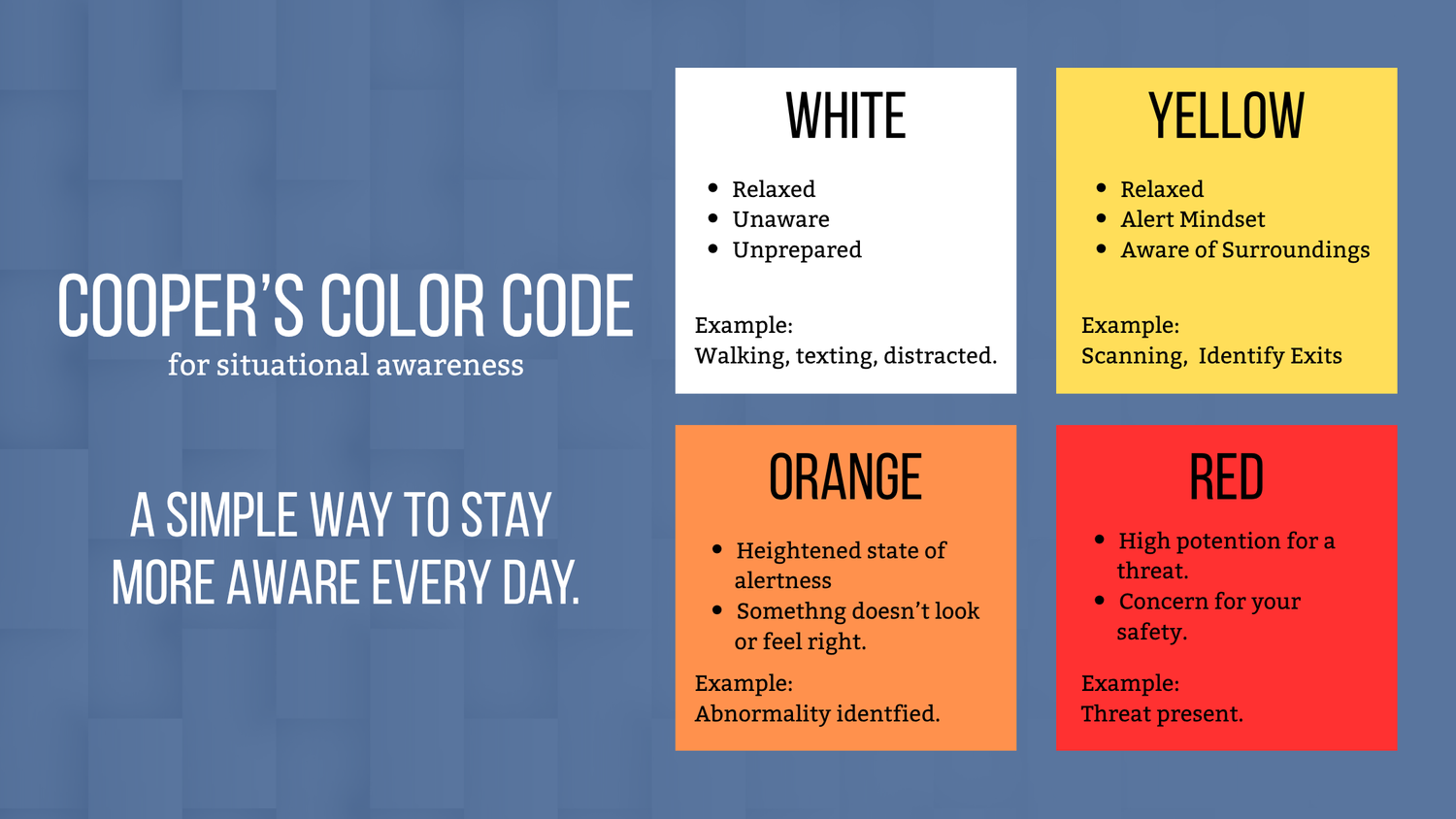
Condition White — Unaware and Unprepared
The state most people live in. You’re absorbed in your phone, lost in thought, or on autopilot. If a threat materializes, your brain must go from zero to crisis mode instantly — and that delay can cost you everything.
Common examples: Walking through a parking lot texting. Wearing noise-canceling headphones on public transit. Sitting in your car at a gas station scrolling social media.
Condition Yellow — Relaxed Alert (Your Default)
This is where you want to live. You’re aware but not anxious — casually scanning your environment, noting exits, and paying attention to anything that breaks the normal pattern.
What it looks like: Glancing around a restaurant when you sit down. Scanning a parking lot before getting out. Making brief eye contact with people you pass. You’re not looking for threats — you’re looking for anomalies.
Condition Orange — Specific Alert
Something has triggered your attention. A person is following you. A car has circled the block three times. Your gut says something is off. You’ve identified a specific potential concern and you’re forming a plan: exit routes, where your tools are, how to move toward safety.
This is where preparation meets awareness. If you’ve trained and mentally rehearsed, Condition Orange feels manageable. If you haven’t, it feels like panic.
Condition Red — Action Required
The threat is real and immediate. You execute the plan you formed in Orange — move to your exit, deploy your Byrna SD, call 911. You act decisively because you saw it coming.
Practice transitioning through the Cooper Color Code in real scenarios at our Manteca facility
7 Practical Habits to Build Situational Awareness
Knowing the theory is one thing. Living it is another. Here are seven personal safety tips you can start practicing today.
1. Scan Every Room When You Enter
Every time you walk into a new space, take five seconds: Exits (doors, emergency exits, windows). People (anyone behaving unusually?). Obstacles (what’s between you and the exit?). Over time, this becomes automatic.
2. Limit Phone Use in Public
Your phone is the biggest threat to your awareness. When your face is in a screen, peripheral vision drops to almost nothing and reaction time plummets. Rule of thumb: If you must use your phone in public, stop walking, put your back to a wall, and keep your head up between glances.
3. Trust Your Gut — The “Gift of Fear”
Security expert Gavin de Becker’s The Gift of Fear explains that your subconscious processes danger signals faster than your conscious mind can name them. That “bad feeling”? It’s your brain’s pattern-recognition system at work. Never rationalize it away.
4. Park Smart
Parking is one of your most vulnerable routines. Back into spaces so you can pull out quickly. Choose well-lit spots near entrances. Have keys in hand before you reach your car. Check your back seat. Lock doors immediately once inside.
5. Know Your Neighborhood Patterns
Awareness is easier when you know what “normal” looks like. Pay attention to your neighborhood’s rhythm — who walks their dog when, which cars are usually parked on your street. When something breaks the pattern, your brain flags it automatically.
6. Practice “What If” Mental Rehearsal
Throughout your day, play a quiet game: What if someone tried to grab my bag right now? What if I heard gunshots in this store — where’s the nearest exit? This isn’t paranoia — it’s the same mental rehearsal used by military operators and first responders. Pre-solved scenarios execute faster.
7. Pair Awareness with Preparedness
Situational awareness tells you when something is wrong. Preparedness gives you something to do about it. Carrying a Byrna SD Kinetic Kit means that when you move from Yellow to Orange, you already have a less-lethal option ready. That’s the difference between awareness alone and true self-defense readiness.
Pair your awareness skills with the right tools — shop the Byrna SD Kinetic Kit
Situational Awareness for California-Specific Scenarios
California’s diverse landscape creates unique safety considerations. Here’s how to apply self defense awareness to environments you actually navigate.
Urban Environments — LA, SF, Sacramento
Crowded streets provide cover for pickpockets and follow-home robberies. Keep bags in front of you. Avoid walking between parked cars and buildings. Be especially alert when transitioning between environments — leaving a store, exiting transit.
Trailheads and Parks
Isolated trailheads pose risks for solo hikers and runners. Tell someone your route and return time. Be cautious of people lingering in parking areas who aren’t gearing up. Carry a personal safety tool — cell service isn’t guaranteed on many CA trails.
Gas Stations and ATMs
Common locations for opportunistic crime — you’re stationary and often distracted. Choose well-lit, busy locations. Stay standing outside your vehicle so you can move quickly. Complete your transaction and leave.
Open Houses and Real Estate Showings
Real estate professionals meet strangers in empty buildings regularly. Always share the address and time with someone. Walk the property before clients arrive. Consider carrying a Byrna launcher as a non-lethal safety option.
Real estate professionals: read our full safety guide
Building a Security Mindset
“Isn’t this just paranoia?” No — and here’s the difference.
Fear-based awareness is reactive, anxious, and exhausting. It sees threats everywhere and leaves you drained. Empowerment-based awareness — a true security mindset — is calm, confident, and sustainable. It’s not about expecting the worst. It’s about being prepared for the worst while expecting the best.
Daily Mindset Rituals
- Morning: Before leaving the house, think about where you’re going and set an intention to stay in Condition Yellow.
- Transitions: Every time you move between environments — car to store, office to parking lot — use it as a trigger to scan and reset.
- Evening: Briefly reflect. Were there moments you slipped into White? What triggered it?
These rituals take minutes but compound into a rock-solid security mindset over time.
Why a security mindset matters for your community
Awareness + Preparedness = True Safety
Here’s the equation: Situational awareness identifies the threat. Preparedness gives you a response.
- Awareness without tools = You see danger coming but can’t respond if avoidance fails.
- Tools without awareness = You have a self-defense option you’ll never deploy in time.
A Byrna launcher bridges the gap between recognizing a threat and responding to it — less-lethal, legal in California without a permit, and effective at creating distance. But it only works if you’ve trained yourself to see the threat early enough to use it.
That’s why we pair situational awareness training with hands-on Byrna proficiency at our Manteca facility. Carrying a tool you haven’t trained with, in a mind that hasn’t practiced awareness, isn’t a safety plan. It’s wishful thinking.
Train Your Awareness at Less Lethal California
Reading about situational awareness is a great start. The real transformation happens when you practice in realistic, scenario-based training.
At Less Lethal California’s training facility in Manteca, we offer:
- Scenario-based drills where you practice identifying threats and making decisions under pressure
- Byrna launcher proficiency so your muscle memory matches your mental readiness
- Range time on our dedicated shooting range to practice deploying your Byrna accurately
- Personalized coaching tailored to your daily environments — commuter, parent, real estate pro, or college student
You’ll walk out with more than knowledge. You’ll walk out with confidence — the quiet, earned kind that comes from knowing you can see a threat coming and do something about it.
Book your situational awareness and Byrna training session today
Frequently Asked Questions
How can I improve my situational awareness?
Start with the seven habits above — especially scanning rooms when you enter, limiting phone use in public, and practicing “what if” mental rehearsal. The biggest single change is training yourself to live in Condition Yellow rather than Condition White. For accelerated improvement, take a hands-on training course that tests your awareness under realistic pressure.
What is the Cooper Color Code?
The Cooper Color Code is a mental awareness system developed by Marine Lt. Col. Jeff Cooper. It defines four levels: White (unaware), Yellow (relaxed alert — your ideal default), Orange (specific alert — something concerns you), and Red (action — confirmed threat requiring immediate response). It’s the foundation of self defense awareness used by professionals worldwide.
Is situational awareness training available near me in California?
Less Lethal California in Manteca offers scenario-based situational awareness training paired with Byrna launcher proficiency courses. We’re California’s first Byrna-dedicated training facility and welcome all experience levels — complete beginners to experienced carriers looking to sharpen their skills.
What should I do if I sense danger in public?
Trust your instincts first. Move toward other people or a well-lit area. Create distance from the source of concern. Make eye contact if safe — this signals you’re aware and not an easy target. Have your phone ready for 911. If you carry a Byrna SD, ensure it’s accessible. And always have an exit plan — which you’ll already have if you’ve been practicing Condition Yellow.
Your Next Step: Stop Reading, Start Practicing
For the next seven days, practice one new habit from this list each day. By the end of the week, you’ll notice a difference in how you move through the world — more present, more confident, more in control.
When you’re ready to take it further — to train your awareness alongside a less-lethal tool that gives you real options — come see us. Less Lethal California is California’s first Byrna-dedicated training facility in Manteca, CA. We’ll help you build the situational awareness and the hands-on skills to back it up.
Your safety isn’t about luck. It’s about preparation. And preparation starts now.
Book your training session at Less Lethal California — Manteca, CA